


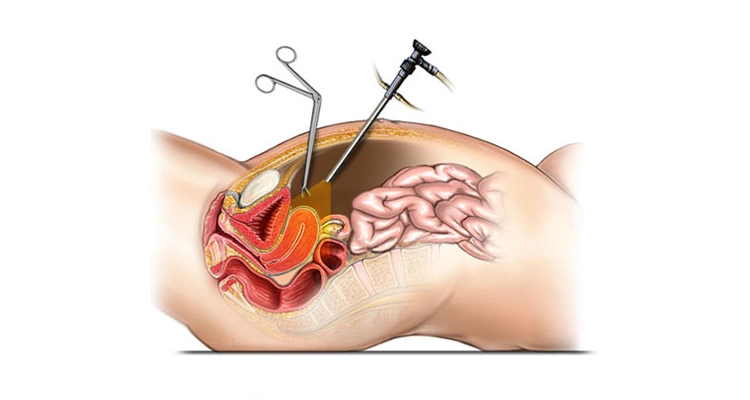
Female infertility can be caused by conditions affecting the ovaries, fallopian tubes, uterus, or pelvic cavity. In many cases, these conditions cannot be diagnosed accurately through ultrasound or blood tests alone. Diagnostic & Operative Laparoscopy in Jaipur is an advanced minimally invasive (keyhole) surgical procedure that helps identify and treat fertility-related conditions in a single session.
At Anmol Fertility Center, Jaipur, Dr. Sapna Basandani offers advanced laparoscopic surgery using modern technology to diagnose and manage various gynecological and infertility conditions while ensuring faster recovery and minimal discomfort.
Diagnostic Laparoscopy is a minimally invasive surgical procedure that allows the doctor to examine the pelvic organs, including the uterus, ovaries, fallopian tubes, and surrounding tissues. A thin instrument called a laparoscope, equipped with a high-definition camera, is inserted through a small incision near the navel to provide a clear view of the reproductive organs.
This procedure helps identify conditions that may affect fertility or cause chronic pelvic pain.
Operative Laparoscopy is performed when abnormalities are detected during diagnostic evaluation or imaging. Specialized laparoscopic instruments are inserted through small incisions to treat the identified condition without the need for open surgery.
Laparoscopy Surgery in Jaipur allows many fertility-related conditions to be diagnosed and treated through a minimally invasive approach, reducing the need for traditional open procedures.
In many cases, diagnosis and treatment can be completed during the same procedure, reducing the need for additional surgeries.
Your fertility specialist may recommend laparoscopy if you have:
Removal or treatment of endometrial tissue growing outside the uterus to improve fertility and reduce pelvic pain.
Removal of ovarian cysts while preserving healthy ovarian tissue whenever possible.
Assessment and treatment of tubal blockages that may affect natural conception.
Removal of scar tissue that restricts normal movement of reproductive organs.
Removal of selected fibroids that may interfere with fertility or pregnancy.
Diagnosis and surgical management of ectopic pregnancy when clinically indicated.
Provides a direct view of the pelvic organs, allowing precise diagnosis of fertility-related conditions.
Small incisions lead to less pain, reduced blood loss, and minimal scarring.
Many abnormalities can be corrected during the same surgery.
Most patients recover more quickly compared to traditional open surgery.
Treating conditions such as endometriosis, adhesions, fibroids, or tubal disease may improve the chances of natural conception or enhance the success of fertility treatments in appropriate patients.
Dr. Sapna Basandani reviews your medical history, fertility investigations, and imaging studies to determine whether laparoscopy is appropriate.
The procedure is performed under general anesthesia for patient comfort.
Tiny incisions are made in the abdomen, and carbon dioxide gas is introduced to create space for better visualization.
A laparoscope with a high-definition camera is inserted to examine the reproductive organs.
If abnormalities are found, specialized laparoscopic instruments are used to perform the required treatment during the same procedure whenever possible.
Recovery is generally faster than with open surgery.
Patients can usually expect:
Recovery time varies depending on the complexity of the procedure.
Dr. Sapna Basandani provides comprehensive infertility diagnosis and minimally invasive surgical care tailored to each patient’s reproductive needs.
Our center utilizes modern laparoscopic equipment to deliver precise diagnosis and effective treatment through advanced Laparoscopy Surgery in Jaipur.
Anmol Fertility Center offers fertility evaluation, ovulation induction, IUI, IVF, ICSI, fertility preservation, embryo freezing, recurrent pregnancy loss management, and minimally invasive gynecological surgery.
Every treatment plan is individualized with compassionate support throughout your fertility journey.
The procedure is performed under general anesthesia. Mild discomfort after surgery is common and usually resolves within a few days with appropriate medication.
Depending on the condition being treated, laparoscopy may take between 30 minutes and several hours.
Many laparoscopic procedures are performed as day-care or short-stay surgeries. Your doctor will advise you based on your individual condition.
If infertility is caused by treatable conditions such as endometriosis, adhesions, ovarian cysts, or blocked fallopian tubes, laparoscopic surgery may improve fertility outcomes.